The original report was filled with overt racism. It claimed that Japanese Americans could never be trusted, stating:
“The Japanese race is an enemy race and while many second and third generation Japanese born on United States soil, possessed of United States citizenship… the racial strains are undiluted.”
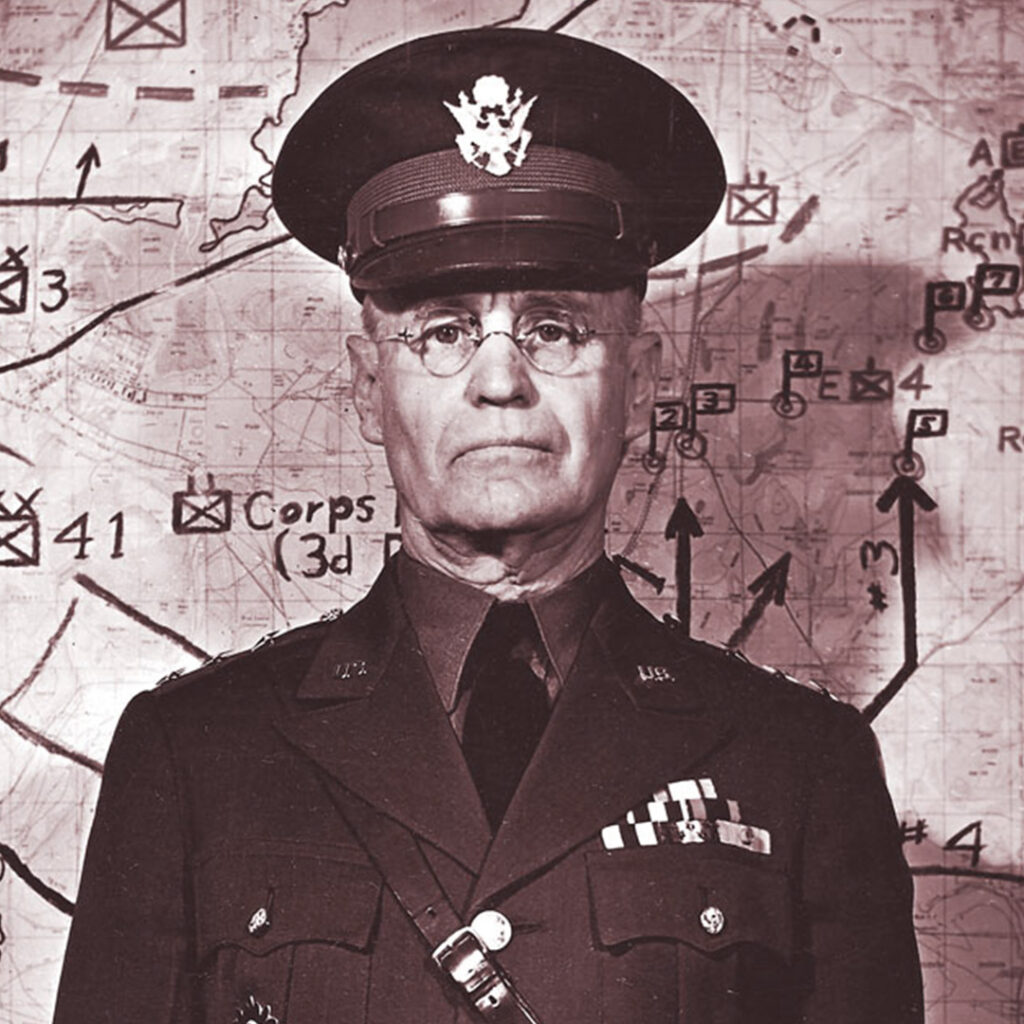
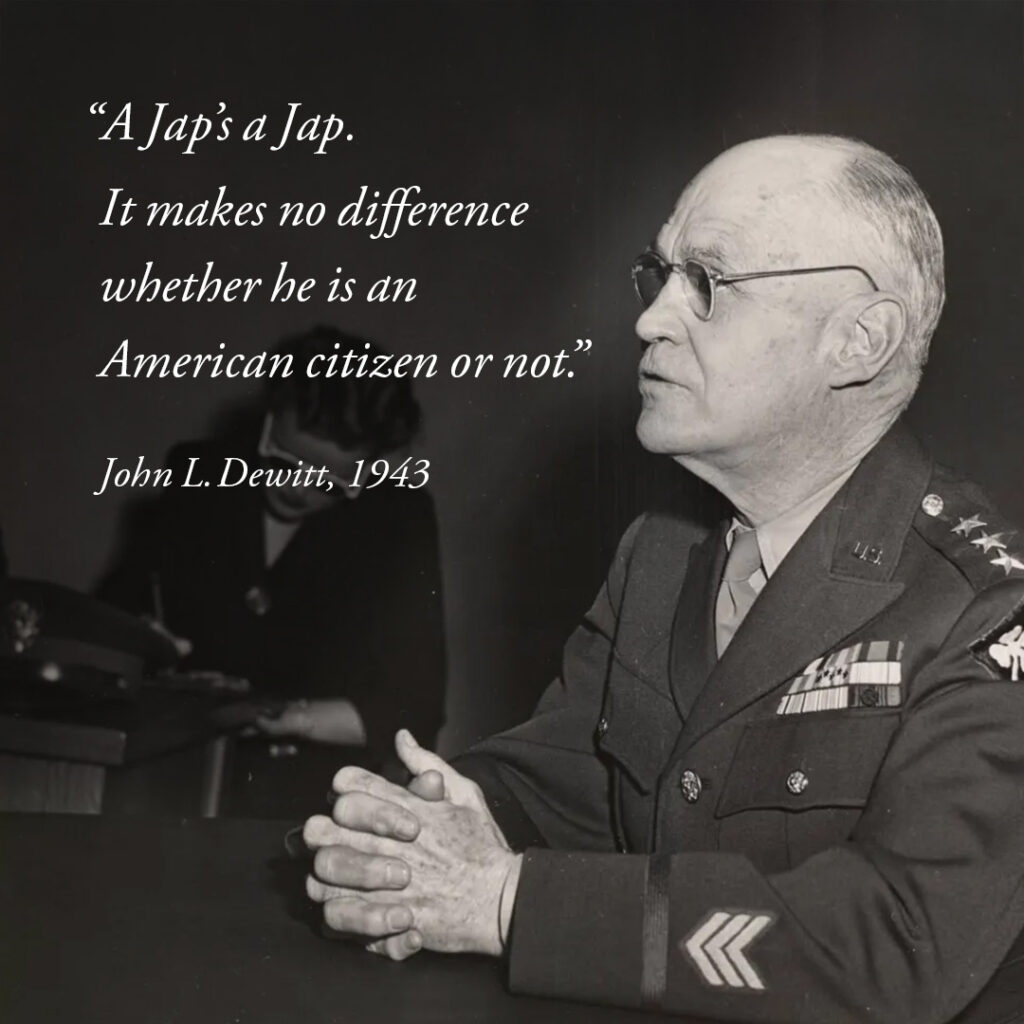
Lieutenant General John L. DeWitt: The man behind the incarceration of 120,000 Americans.
He led the campaign to remove and imprison anyone of Japanese ancestry.
The first group of Japanese-Americans arrive at the Manzanar War Relocation Center, one of ten major incarceration camps during WWII, 1942
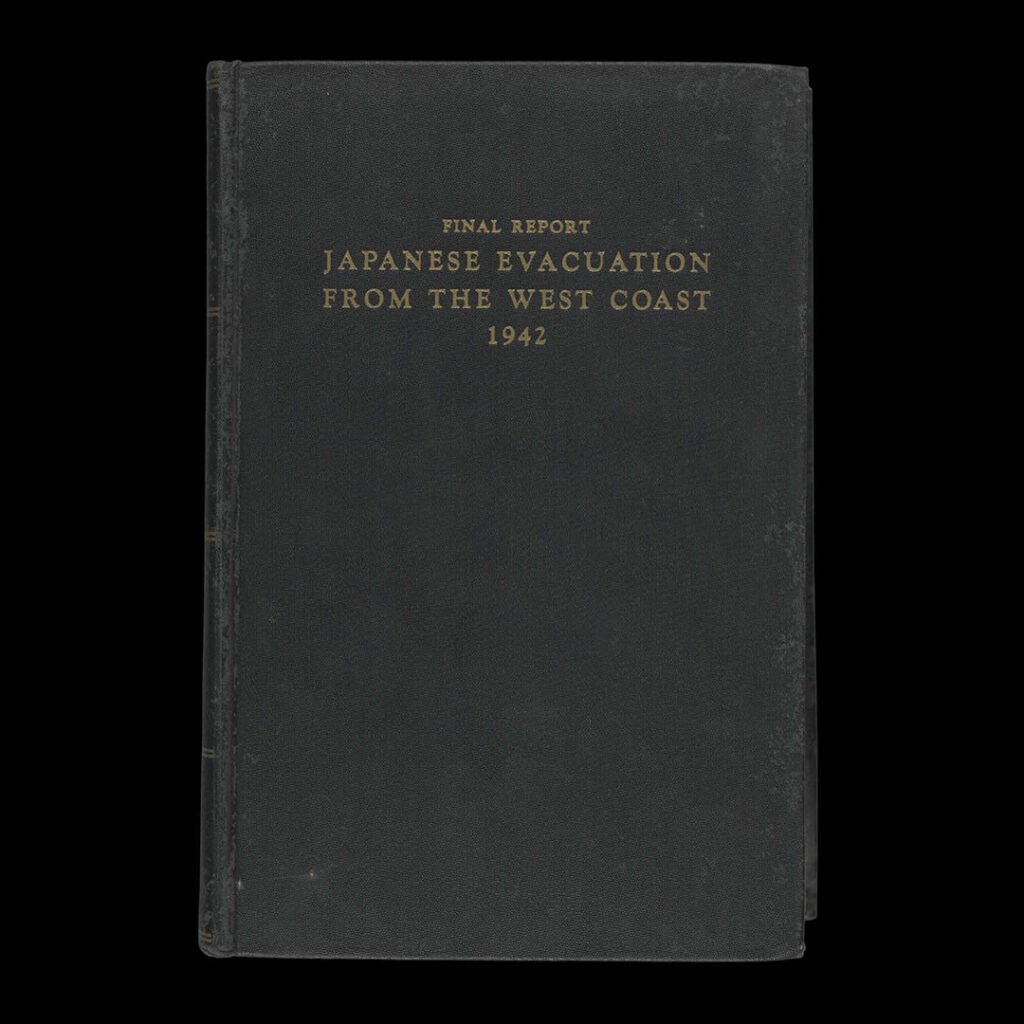
Gen. DeWitt had ten copies of Final Report printed in April 1943 without authorization from the War Department. It was filled with sweeping, racist claims.
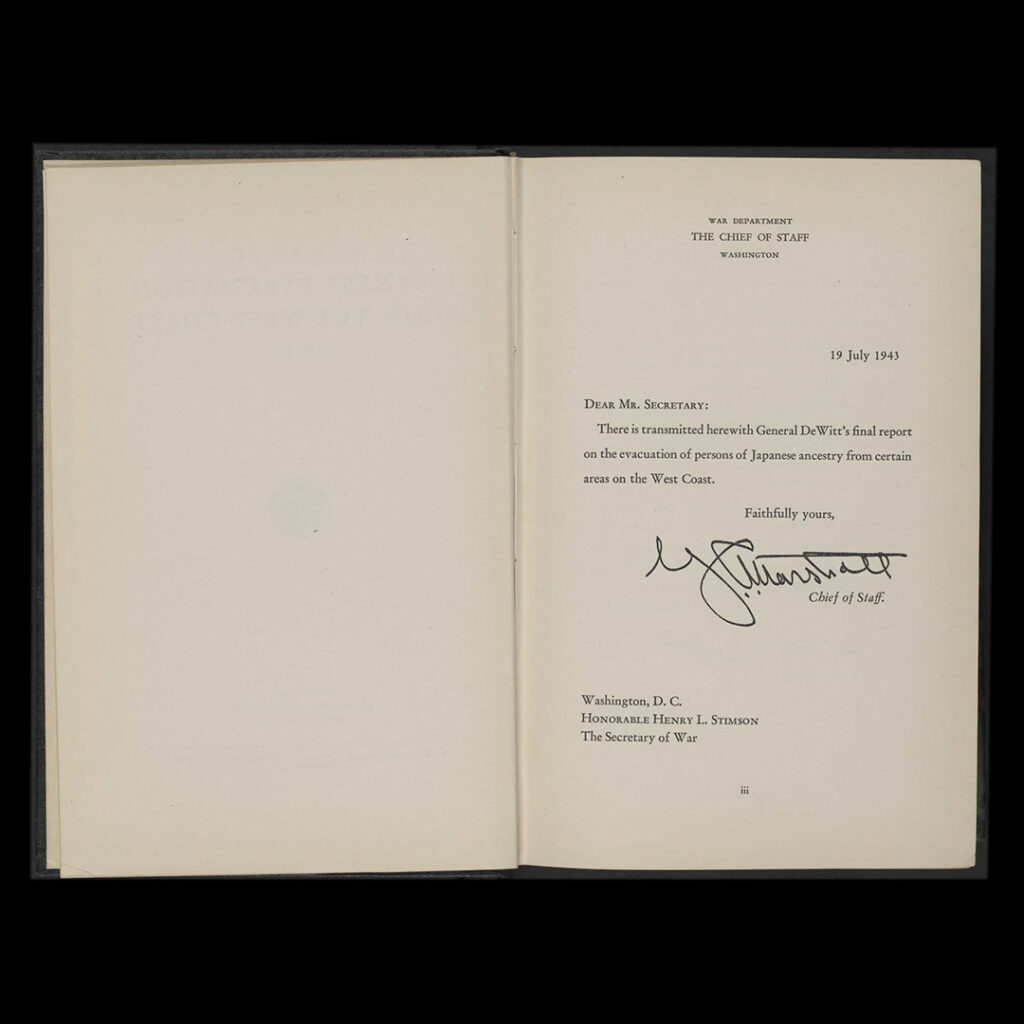
Introductory pages to the edited Final Report, dated July 19, 1943. The original version was deemed too inflammatory for public release.
Fred Korematsu speaks after his wartime conviction was overturned — a decision made possible by the decades-long efforts.
Guilty Until Proven Guilty
It also claimed that the lack of sabotage on the West Coast actually proved that an attack was imminent. This backwards logic would be cited again and again as a justification for the incarceration. In other words, the Japanese Americans were guilty until proven guilty.
The War Department quietly shelved the original. It was too racist — even in 1943.
A heavily edited version was finally published on July 19, 1943. Gone were the most overtly racist claims. In their place: sanitized language, carefully crafted to sound neutral and military-driven.
However, the edited version still defended incarceration.
The Smoking Gun
What the public didn’t know: The original report had been buried. Until a political activist, Aiko Herzig-Yoshinaga, discovered it decades later in the National Archives.
She found the “smoking gun.”
Civil rights attorneys A.L. Wirin and Wayne Collins referenced the original, unredacted draft in 1944 while preparing legal challenges to the Japanese American incarceration. The differences between the two versions were undeniable.
It proved the government had tried to erase its own racism.
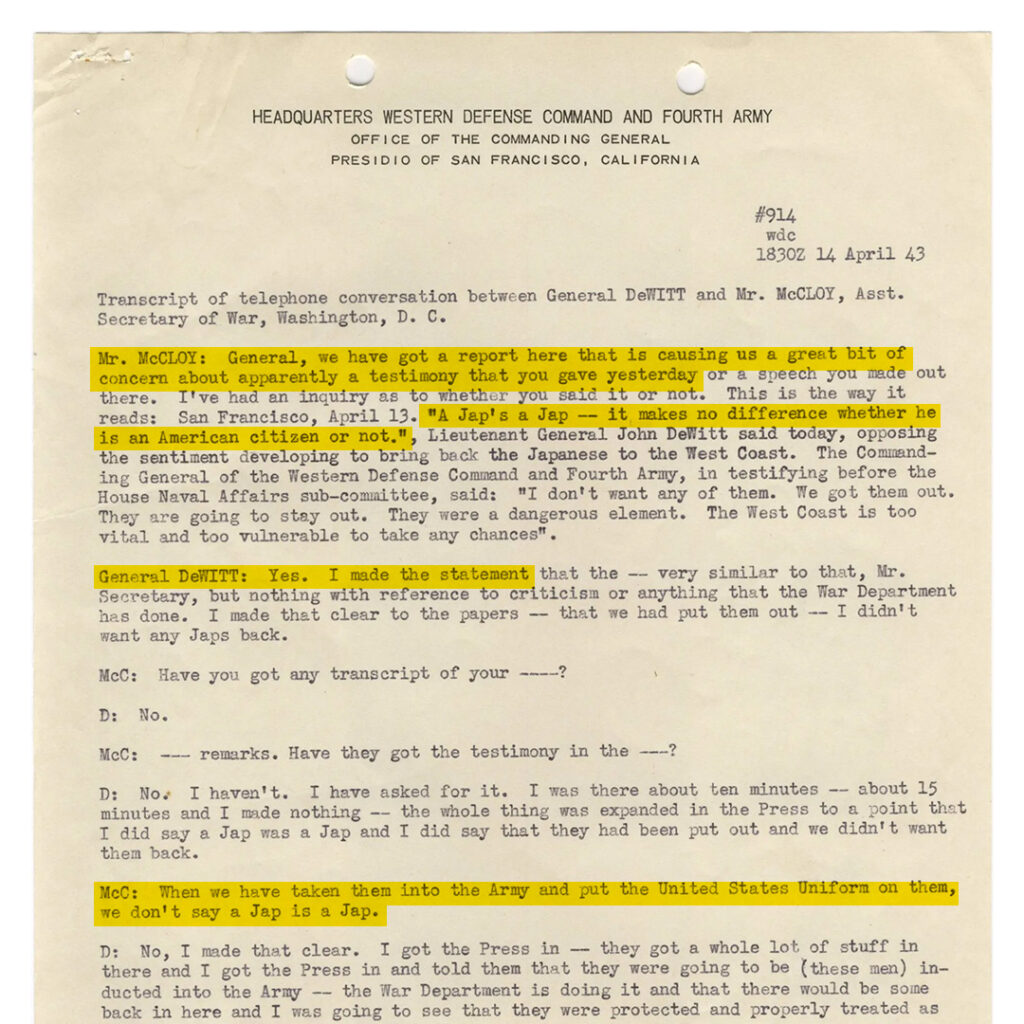
DeWitt’s racism was known to be unfiltered. In this transcript of his phone conversation with his superior, he fully admits to making public racist remarks.
This wasn’t a private remark. General DeWitt was regularly making these statements publicly, justifying the incarceration of 120,000 Japanese Americans.
The original “Final” Report became a powerful tool in unraveling the myth that incarceration was a military necessity.
It exposed what officials had tried to remove and became crucial evidence in the coram nobis cases, helping overturn the wartime convictions of Fred Korematsu, Gordon Hirabayashi, and Minoru Yasui.
The report also helped pave the way for the Civil Liberties Act of 1988, in which the United States formally apologized and provided redress to surviving Japanese American incarcerees.
It wasn’t easy to erase everything. Fortunately, they failed.
I posted a comment on the Quiet Americans Facebook page related to the “It wasn’t easy to hide racism, especially after it WAS PRINTED,” which featured the role General DeWitt had in the Japanese internment. Even though the original report had been “whitewashed” of the overtly racist language (even for the time), someone sensed the original should be scrutinized. That someone was Aiko Herzig-Yoshinaga, who undoubtedly labored long and hard to locate the original. Described as the smoking gun, it was more of a tool to expose the lack of justification for the internment action and the convictions of Korematsu, Hirabayashi, and Yasui. I don’t recall if “Personal Justice Denied” specifically made reference to the original report, although it too found that the military necessity justification did not hold water.
The sadness is that suppression of the truth, the racist animus that produced an over 600-page report, reflects a more disturbing practice: the lengths the government is willing to go to “paint a picture” that the general public would not question. Against the constitutional protections that should have been present, the Supreme Court appeared to give protection to Alien Land Act laws, influenced by the type of rhetoric of military necessity, which was noted in (ironically) Trump v Hawaii. None of it should have added up, but a deference was given to the claims, much later proven false.
Who is at fault? Who knows? The wheels of justice are slow, but rest on men (and also women) judges who may not fully embrace the rule of law due to their own personal limitations, and yes, prejudice. It did not occur to me when I commented that it still has prevailed. The most recent reflection is the elimination of affirmative action by the Supreme Court, eradicating the evolution of the law before it to repudiate racist laws or actions of the government.
History, as I posted, has not taught our country to learn.
To add more, a 2004 law review article provided a preface as follows:
In the early 1980s, Fred Korematsu, Minoru Yasui, and Gordon Hirabayashi marched back into the federal courts that convicted them during World War II for defying the internment of persons of Japanese descent. Relying on suppressed exculpatory evidence discovered in the national archives, they filed writs of error coram nobis to overturn their convictions. Remarkably, this litigation was successful and fueled the extraordinary redress movement, which culminated in federal reparations for surviving internees. Yet, a dark side to this victory has never been discussed, until now. In granting the petitions, the Judiciary absolved the one branch of government that has never been held accountable for the internment: itself. Specifically, the lower federal courts adopted an official legal history that insulated the wartime Supreme Court from any fault. According to that account, the Supreme Court was simply duped by conniving officials in the Departments of War and Justice, who suppressed “smoking gun” evidence. But this tidy story is nonsense. The wartime Court was no innocent. It was a full participant in the internment machinery, and it deployed its enormous intellectual resources to avoid interfering with the internment, while at the same time, never granting it official approval. The Court also made certain that blame would fall not on President Franklin Delano Roosevelt or on Congress, but instead on the little known War Relocation Authority, which was labeled a rogue agency. This is what the Court did in the 1940s, exploiting procedure-like tools often extolled as “passive virtues.” The Judiciary has never accepted responsibility for its machinations. After the coram nobis cases, official history has been rewritten to make any apology simply unwarranted. In this way, the personal victories of Korematsu, Yasui, and Hirabayashi were ironically exploited to complete the circle of absolution the Supreme Court began in the 1940s. This Article provides a more nuanced and disturbing interpretation of the internment, *934 the Judiciary, and the coram nobis cases. It also sheds critical light on discussions of military exigency, racism, the role of the Judiciary, and the lessons of history in a post-September 11 world.
Jerry Kang, Denying Prejudice: Internment, Redress, and Denial, 51 UCLA L. Rev. 933, 933–34 (2004)


I posted a comment on the Quiet Americans Facebook page related to the “It wasn’t easy to hide racism, especially after it WAS PRINTED,” which featured the role General DeWitt had in the Japanese internment. Even though the original report had been “whitewashed” of the overtly racist language (even for the time), someone sensed the original should be scrutinized. That someone was Aiko Herzig-Yoshinaga, who undoubtedly labored long and hard to locate the original. Described as the smoking gun, it was more of a tool to expose the lack of justification for the internment action and the convictions of Korematsu, Hirabayashi, and Yasui. I don’t recall if “Personal Justice Denied” specifically made reference to the original report, although it too found that the military necessity justification did not hold water.
The sadness is that suppression of the truth, the racist animus that produced an over 600-page report, reflects a more disturbing practice: the lengths the government is willing to go to “paint a picture” that the general public would not question. Against the constitutional protections that should have been present, the Supreme Court appeared to give protection to Alien Land Act laws, influenced by the type of rhetoric of military necessity, which was noted in (ironically) Trump v Hawaii. None of it should have added up, but a deference was given to the claims, much later proven false.
Who is at fault? Who knows? The wheels of justice are slow, but rest on men (and also women) judges who may not fully embrace the rule of law due to their own personal limitations, and yes, prejudice. It did not occur to me when I commented that it still has prevailed. The most recent reflection is the elimination of affirmative action by the Supreme Court, eradicating the evolution of the law before it to repudiate racist laws or actions of the government.
History, as I posted, has not taught our country to learn.
To add more, a 2004 law review article provided a preface as follows:
In the early 1980s, Fred Korematsu, Minoru Yasui, and Gordon Hirabayashi marched back into the federal courts that convicted them during World War II for defying the internment of persons of Japanese descent. Relying on suppressed exculpatory evidence discovered in the national archives, they filed writs of error coram nobis to overturn their convictions. Remarkably, this litigation was successful and fueled the extraordinary redress movement, which culminated in federal reparations for surviving internees. Yet, a dark side to this victory has never been discussed, until now. In granting the petitions, the Judiciary absolved the one branch of government that has never been held accountable for the internment: itself. Specifically, the lower federal courts adopted an official legal history that insulated the wartime Supreme Court from any fault. According to that account, the Supreme Court was simply duped by conniving officials in the Departments of War and Justice, who suppressed “smoking gun” evidence. But this tidy story is nonsense. The wartime Court was no innocent. It was a full participant in the internment machinery, and it deployed its enormous intellectual resources to avoid interfering with the internment, while at the same time, never granting it official approval. The Court also made certain that blame would fall not on President Franklin Delano Roosevelt or on Congress, but instead on the little known War Relocation Authority, which was labeled a rogue agency. This is what the Court did in the 1940s, exploiting procedure-like tools often extolled as “passive virtues.” The Judiciary has never accepted responsibility for its machinations. After the coram nobis cases, official history has been rewritten to make any apology simply unwarranted. In this way, the personal victories of Korematsu, Yasui, and Hirabayashi were ironically exploited to complete the circle of absolution the Supreme Court began in the 1940s. This Article provides a more nuanced and disturbing interpretation of the internment, *934 the Judiciary, and the coram nobis cases. It also sheds critical light on discussions of military exigency, racism, the role of the Judiciary, and the lessons of history in a post-September 11 world.
Jerry Kang, Denying Prejudice: Internment, Redress, and Denial, 51 UCLA L. Rev. 933, 933–34 (2004)
Is the full report available anywhere?
The April 1942 version is available for download here:
https://digitalcommons.usm.maine.edu/oml_collections/30/