He wanted to be an artist and a writer. He died not knowing he already was.
December 23, 1925: Stanley Hayami was born in Los Angeles. He left behind letters, diaries, and drawings that give us a rare insight into the life of a young Japanese American man inside an incarceration camp and later on the battlefield during World War II.
At sixteen, Stanley was incarcerated with his family, first at the Pomona Assembly Center and then at the Heart Mountain concentration camp in Wyoming.
What makes his story different is not only what happened to him, but what he recorded while it was happening.
In his diary, Stanley wrote about schoolwork, movies, sports scores on the radio, and daily frustrations. He filled the pages with pen-and-ink drawings and cartoons. He worried about his future, sometimes doubted his own intelligence, and dreamed of becoming an artist or a writer anyway.
These were not retrospective memories. They were written in real time, behind barbed wire.
Looking west of F Street with Heart Mountain looming in the background, 1942. Photo by Tom Parker, credit The Bankroft Library, University of California, Berkeley
Stanley Hayami (center) sits beside his brother Walt in the mess hall at Heart Mountain. The meals were communal, but so was the loss of freedom.
In “Reminiscing,” by Stanley Hayami, he drew his old home in San Gabriel (top) and his new reality at Heart Mountain (bottom).
“Happy guy ain’t I!” On December 13, 1942, Stanley Hayami celebrated UCLA’s 14–7 win over USC from behind barbed wire at Heart Mountain.
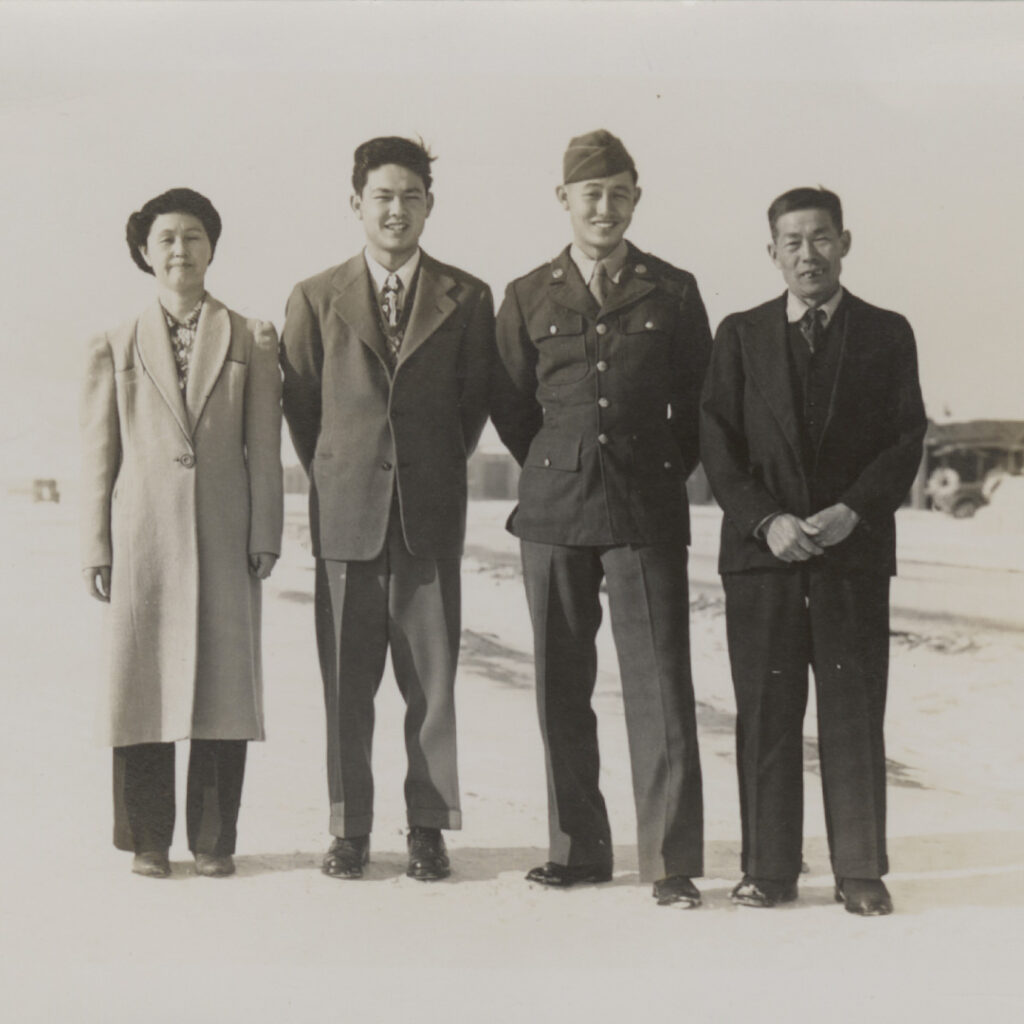
Stanley Hayami (second from right) visiting his family at Heart Mountain after completing Army training, and just before getting shipped out to Europe.
Stanley Hayami drew this lighthearted cartoon in March 1945, poking fun at Army life in Europe — mule convoys, mountain climbs, and the time he came down with measles.
Writing From War
In 1944, Stanley graduated from Heart Mountain High School and served as art editor for the camp’s Tempo yearbook. Weeks later, his induction notice arrived.
On August 22, 1944, Stanley reported for basic training. That day marked his last day at Heart Mountain and the final entry in his diary.
After basic training at Fort Blanding, Florida, Stanley was deployed to Europe with the 442nd Regimental Combat Team. He wrote often, especially to his sister Sach in New York and to his parents and brother Walt, who were still incarcerated.
His letters rarely complained. He was probably trying to keep his family from worrying.
Even from overseas, Stanley continued to draw, filling his letters with cartoons that echoed the diary sketches he had made in camp.
Bronze Star and Purple Heart
In the spring of 1945, Stanley’s unit was sent to northern Italy. On April 18, he wrote his last letter from “somewhere in Italy.”
Days later, during fighting near San Terenzo, Stanley Hayami left a protected position to render medical aid to wounded soldiers. He was killed under fire while providing aid to his fellow soldiers.
He was nineteen.
For his selfless actions, Private Hayami was posthumously awarded the Bronze Star Medal and the Purple Heart.
Private Stanley Hayami, 2nd Battalion, Company C, 442nd Regimental Combat Team. He was awarded the Bronze Star and Purple Heart for his heroism in Italy.
The Purple Heart Medal, credit The National WWII Museum, New Orleans
Stanley Hayami was just a teenager when he was incarcerated, and later sent to war. But through his diary, letters, and drawings, he left behind a remarkable legacy.
The Stanley Hayami Diary
Stanley Hayami’s diary and letters survived. His family recovered and preserved them.
Today, they are part of the permanent collection of the Japanese American National Museum. His words and drawings later became the book Stanley Hayami, Nisei Son and the film A Flicker in Eternity.
They give us something rare: a teenage voice that carries us from incarceration to war without the distance of hindsight.
He wanted to be an artist, and he wanted to be a writer. Although he died as a soldier, history tells us he was already both.