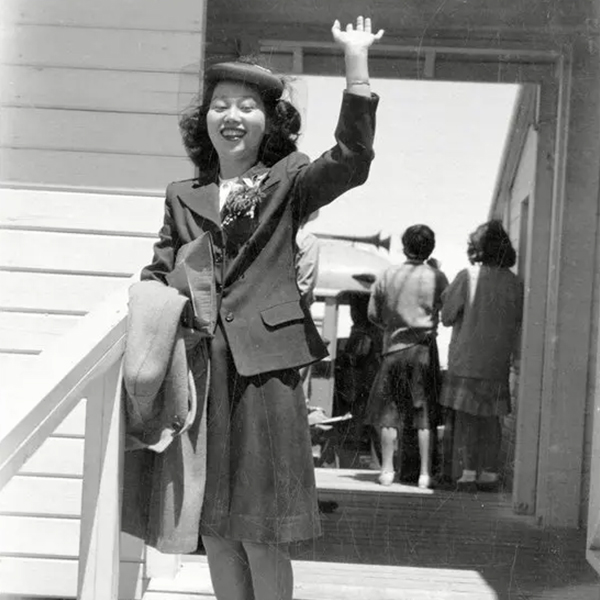
He needed the perfect plaintiff to challenge the U.S. government. He found Mitsuye Endo.
July 13, 1942: attorney James C. Purcell filed a writ of habeas corpus on behalf of Mitsuye Endo.
James C. Purcell had grown up around incarceration. His father had been a guard at Folsom Prison, one of California’s most notorious penitentiaries. Purcell knew what prison cells looked like. He knew what “confinement” meant.
But when he visited the Tanforan Assembly Center in the spring of 1942, what he saw shocked him. Japanese Americans were being housed in horse stalls. Families crammed into quarters still reeking of manure. Armed soldiers patrolled from towers. The atmosphere was suffocating, humiliating.
At the time, Purcell was a young attorney in Sacramento working for the California State Personnel Board. Like many civil servants, he had followed the government’s new exclusion orders, and he had seen the ripple effects firsthand: Japanese American state employees were being fired en masse, often without any due process.
At least Folsom Prison, one of the first maximum-security prisons in the United States made famous by Johnny Cash, was built for humans, not horses.
Tanforan Racetrack, 1942. Within days, the grandstands were filled with barbed wire, and the stables became prison cells. Purcell reported some stalls had been whitewashed over patches of horse manure.
Horse stalls turned into incarceration barracks at Tanforan Assembly Center. Japanese Americans were forced to sleep in rooms reeking of manure.
Mitsuye Endo, a loyal U.S. citizen, fired from the state of California without a cause. Her courage helped bring the camps down.
The Perfect Plaintiff
One of those dismissed employees was Mitsuye Endo, a quiet Nisei typist from Sacramento. An American citizen by birth, she didn’t speak Japanese, had never visited Japan, was a practicing Christian, worked for the California Department of Employment, and had never been accused of any crime.
Her brother was serving in the U.S. Army, and even federal investigators found no evidence she posed any security threat.
To James Purcell, she was the perfect plaintiff.
If the government could imprison someone like Endo without cause, then its entire justification for the incarceration rested on dangerous constitutional ground.
Dedication and Sacrifice
The lawsuit did not bring Endo immediate freedom.
Government officials repeatedly offered to release her if she agreed to leave California and relocate elsewhere. Accepting those offers, however, would likely have ended her case before the courts could rule on its constitutional merits.
Instead, Endo chose to remain behind barbed wire while her case slowly worked its way through the federal courts, sacrificing more than two years of her freedom so the legal challenge could continue.
On December 18, 1944, the Supreme Court unanimously ruled in Ex parte Endo that the government could not continue detaining concededly loyal American citizens. Just one day earlier, the War Department had quietly announced that the exclusion orders would be lifted and the camps would begin closing.
Endo’s quiet determination helped bring one of the darkest chapters in American history to an end.
Mitsuye Endo leaving Topaz, Utah, in 1945
Mitsuye Endo’s article after her passing in 2006
James Purcell worked with attorney A.L. Wirin (left) to challenge California’s racist Alien Land Law — a law that banned Japanese immigrants like Kajiro Oyama (right) from owning property.
In early 1951, attorney James Purcell represented the family of JACL leader Mike Masaoka (left) in another landmark case against California’s ban on Issei land ownership.
Crucial Cases
To this day, Mitsuye Endo remains one of the most important but least-known figures in the fight for civil liberties in America. But Purcell’s work didn’t stop there.
He also partnered with attorney A.L. Wirin to submit an amicus brief on behalf of the Japanese American Citizens League in Oyama v. California, a challenge to the state’s Alien Land Law. In 1950, he represented the family of JACL leader Mike Masaoka in a key lawsuit contesting California’s lingering ban on Issei land ownership. After that victory, Purcell helped numerous Issei verify their ownership of land and prevent local authorities from seizing property based on ignorance of the ruling.
Decades later, Purcell quietly advised California State Assemblymember Patrick Johnston, who introduced legislation that ultimately passed in 1982. The law provided $5,000 in compensation to 314 surviving Japanese Americans who had been wrongfully fired from California state jobs during WWII.
Positive Changes
Purcell continued practicing law into his 80s, representing unions, political leaders, and businesses. He passed away at the age of 84, having spent most of his life using the law to protect civil liberties.
Perhaps history changed the moment he stepped into Tanforan — a living condition much worse than convicts.
Purcell spent his legal career challenging racist laws in California, helping overturn some of the most discriminatory policies of his time, credit Kathleen Purcell and Densho