A 20-minute attack started an imaginary battle and a real mass incarceration.
February 23, 1942: A Japanese submarine shelled the California coast. Although the damage was minimal, it triggered immense hysteria leading to the acceleration of Japanese American removal.
After Pearl Harbor, fear gripped California.
Seven Japanese submarines patrolled the Pacific coast in the weeks that followed. Merchant ships were attacked. Two were sunk. Six more were damaged.
Anti-aircraft guns were placed across the West Coast. Blackouts were enforced. The idea of attack no longer seemed hypothetical.
Hysteria was growing.
Five hundred U.S. Army troops were stationed at the Walt Disney Studios lot in Burbank to defend against possible invasion.
After Pearl Harbor, anti-Japanese groups gained enormous political power. What followed wasn’t just fear, but a coordinated push to remove an entire community.
Courtesy of National Archives at Boston
16" barbette gun mount, Watertown Arsenal, 1938. This coastal defense gun was later installed in San Francisco during WWII as part of the West Coast’s anti-invasion defenses.
Courtesy of Imperial Japanese Navy Photograph Archive
Imperial Japanese Navy submarine I-17, in 1939. On February 23, 1942, I-17 surfaced off the California coast and shelled the Ellwood oil field near Santa Barbara.
U.S. soldiers inspecting damage at the Ellwood oil pier, February 24, 1942. The Bombardment of Ellwood caused minor structural damage. No one was killed or injured.
Courtesy of Paul D. Petrich Jr.
The Japanese submarine I-17 fired between 12 and 25 shells. Property damage was limited, as seen here. The psychological impact was far greater.
The 20-minute Attack and $500 Damage
One of those submarines was the Imperial Japanese Navy’s I-17, commanded by Kozo Nishino.
In the evening of February 23, 1942, the submarine stopped offshore near the Ellwood oil field. Around 7:15 p.m., its 14-cm deck gun opened fire.
Shells landed near aviation fuel storage tanks. Workers initially believed they were hearing internal explosions. For roughly twenty minutes, the I-17 fired between 12 and 25 shells.
It destroyed a derrick and a pump house. It damaged a pier and a catwalk. Property damage was estimated at $500.
There were no casualties.
The “Battle of Los Angeles”
The next evening, reports of lights in the sky over Los Angeles caused American anti-aircraft batteries to fire more than 1,400 shells into the night sky. Five civilians died — three in car crashes during blackout confusion, two from heart attacks brought on by stress.
But no enemy aircraft were found. Later, in 1983, the U.S. Office of Air Force History concluded the episode was a case of “war nerves,” likely triggered by a weather balloon.
The episode was later derisively labeled the “Battle of Los Angeles” or the “Great Los Angeles Air Raid.”
These five civilians wouldn’t be the only victims.
Searchlights over Los Angeles during the anti-aircraft barrage later known as the “Battle of Los Angeles.” More than 1,400 shells were fired. No enemy aircraft were found.
Official U.S. Navy Photograph
Secretary of the Navy Frank Knox. Within hours of the anti-aircraft barrage over Los Angeles, Knox publicly described the incident as a false alarm caused by “war nerves.”
Later military reviews attributed the 1942 “Battle of Los Angeles” to a weather balloon. Five civilians died. (image: U.S. Navy transosonde weather balloon, 1958.)
Front-page coverage of the so-called “Battle of Los Angeles.” Tabloid headlines reported “enemy air raiders,” reinforcing the perception of invasion despite no confirmed aircraft.
Courtesy of National Archives and Records Administration
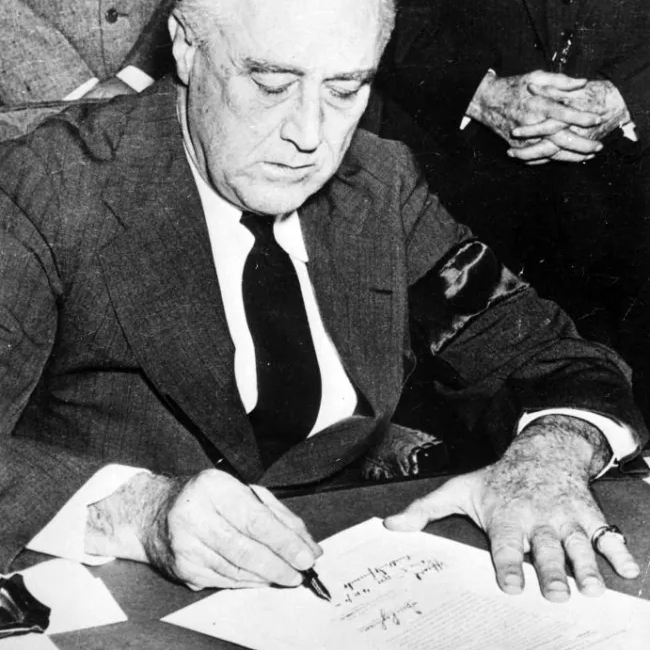
February 19, 1942 — Just few days earliers, FDR signed Executive Order 9066, setting in motion the mass incarceration of over 120,000 Japanese Americans during WWII
Amid mounting fear on the West Coast, DeWitt issued Public Proclamation No. 1, expanding military authority and setting the stage for mass exclusion.
Fear Found Its Proof
Executive Order 9066 had been signed on February 19, just four days before Ellwood. The order did not name Japanese Americans, but military leaders on the West Coast were already pushing for removal. The shelling gave hysteria something tangible.
Reports of “signal lights” in Santa Barbara circulated that night. Blackouts intensified. Rumors spread of enemy collaborators. This “battle” was sensationalized in tabloids all over the place.
No evidence ever tied Japanese Americans to the submarine attack. No sabotage was uncovered.
Still, removal accelerated. Just one week later, on March 2, General DeWitt issued Public Proclamation No. 1, formally beginning the process of mass removal. Within months, more than 120,000 people of Japanese ancestry — two-thirds of them American citizens — were incarcerated. Pearl Harbor set things in motion, Ellwood materialized them.