Eighty years later, it became the official Day of Remembrance. Not that they ever forgot.
February 19, 2022: The day after President Joe Biden signed Proclamation 10341, February 19 was formally designated as the Day of Remembrance of Japanese American Incarceration During World War II.
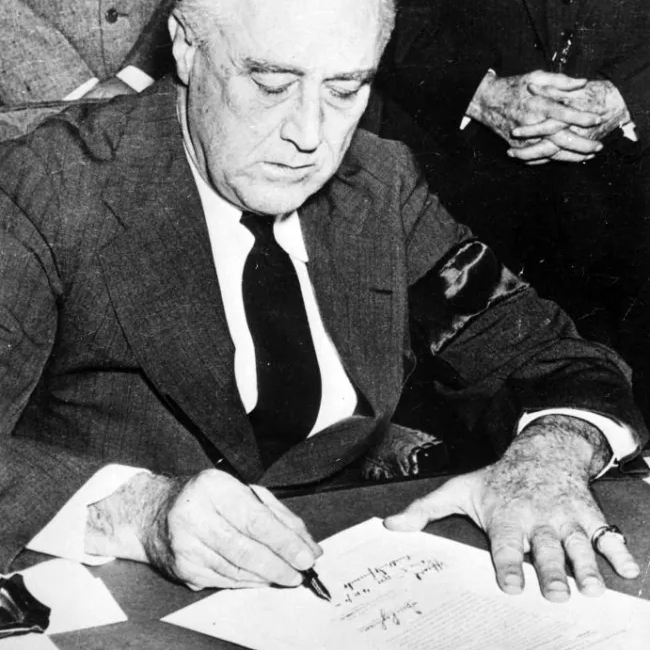
February 19, 1942, President Franklin D. Roosevelt signed Executive Order 9066. The order authorized the forced removal of over 120,000 people of Japanese ancestry from the West Coast, two-thirds of them American citizens.
They were given days to leave their homes. Businesses were sold for pennies. Families were sent behind barbed wire.
The experience scarred generations. For decades, many endured quietly. Gaman. Endure. Do not complain. Many buried their anger and sorrow deep inside. They may not have spoken about it.
But they remembered.
Courtesy of National Archives and Records Administration
February 19, 1942 — Franklin Roosevelt signs Executive Order 9066, setting in motion the mass incarceration of over 120,000 Japanese Americans during WWII
Photography by Dorothea Lange
Families lined up under armed guard, not knowing what would come next. The removal lasted months. The silence lasted generations.
Photography by Dorothea Lange
They were told to bring only what they could carry. What they carried instead were memories and fear that would echo through their children and grandchildren.
Photo by John Harada, courtesy of the Frank Abe Collection
Seattle, November 25, 1978. The first large public Day of Remembrance. Participants gathered before forming a caravan to retrace the route to the Puyallup Assembly Center.
Courtesy of CSU Japanese American Digitization Project
Participants recreated the 1942 removal by organizing a caravan to the former incarceration site. The drive retraced the route families once took under military orders.
The First Day of Remembrance
The first large public Day of Remembrance event was held on November 25, 1978, in Seattle. It was organized to reignite the Japanese American redress movement, which had stalled.
Participants retraced the journey to the Puyallup Assembly Center, recreating the forced removal with a caravan of trucks and cars. What began as commemoration became something deeper.
Something shifted.
Survivors who had long buried their memories began to speak. Some shared their incarceration experiences publicly for the first time. Children and grandchildren heard stories that had never been told at home. Silence gave way to testimony.
A Movement Spreads
Portland followed just a few months later in February 1979. Other cities, including San Francisco and Los Angeles, quickly joined the movement.
Across the country, communities began holding their own commemorations. Many made them official. In 1986, California Governor George Deukmejian declared February 19 a Day of Remembrance. Idaho has marked the day since the early 2000s. Utah has recorded observances dating back to 2005. Alaska’s earliest recorded event was in 2016. Colorado held public commemorations by 2013, and in 2022 the Amache National Historic Site Act established the former incarceration site as a national park. Arizona has recorded events in recent years as well.
These gatherings were not symbolic holidays. They became platforms for education, accountability, and civic engagement.
Courtesy of Densho, Kinoshita Family Collection
Seattle Mayor Charles Royer signs the nation’s first Day of Remembrance proclamation, with JA leaders including Cherry Kinoshita (second from right), November 1978.
Courtesy of the Japanese American Museum of Oregon
Portland, February 17, 1979. Just months after Seattle’s first Day of Remembrance, Oregon held its own public commemoration. It was becoming a movement.
Ronald Reagan Presidential Library and Museum/NARA
August 10, 1988. President Ronald Reagan signed the Civil Liberties Act, formally apologizing for the incarceration of Japanese Americans and authorizing reparations.
Official White House Photo by Eric Scott
President Joe Biden signed Proclamation 10341, formally designating February 19 as the national Day of Remembrance of Japanese American Incarceration during World War II.
Remembering Matters
Within ten years of that first Day of Remembrance, the Civil Liberties Act of 1988 passed, offering a formal apology and reparations to surviving incarcerees. Public testimony from survivors helped galvanize the redress movement.
The country did not change overnight. But it began, slowly, to admit what had happened.
President Joe Biden signed Proclamation 10341 on February 18, 2022 — the day before the 80th anniversary of the signing of Executive Order 9066.
Today, Day of Remembrance events are no longer limited to the Western United States. Observances take place in Alaska, Chicago, Philadelphia, New York City, New England, and beyond. February 19 is now formally recognized nationwide. Because we refuse to forget.