He lost his right arm in war. Then gave the country a lifetime of service.
September 7, 1924: Daniel K. Inouye, one of the most respected and decorated figures in American history: a soldier, senator, and civil rights pioneer, was born in Honolulu, Hawai‘i.
His path was never easy.
Inouye was still a teenager when Japan bombed Pearl Harbor. Like many Japanese Americans, he wanted to prove his loyalty. But the U.S. military initially classified him as an “enemy alien.”
He didn’t give up. When the government finally reversed course and allowed Japanese Americans to enlist in the segregated 442nd Regimental Combat Team, Inouye was one of the first to volunteer.
He was 18.
In Europe, Inouye fought with extraordinary valor. In one of the most heroic acts of World War II, he singlehandedly took out multiple German machine gun nests during a brutal battle in Italy.
Daniel Inouye volunteered to fight for a country that didn’t want him. He rose to the rank of First Lieutenant in the 442nd Regimental Combat Team.
Daniel Inouye getting sworn in as the first Japanese American U.S. Senator, January 9, 1963. A war hero who lost his arm in battle, now raising his remaining hand to serve.
A grenade blast shredded his right arm, which still held a live grenade. With his remaining hand, he pried the explosive from his destroyed limb and hurled it — eliminating the enemy position before collapsing.
He would spend 20 months in military hospitals. His right arm was amputated. So was his dream of becoming a surgeon.
But Inouye found a new path. He studied political science, earned a law degree, and entered public office. He became Hawai‘i’s first U.S. Congressman after statehood, and in 1963, the first Japanese American U.S. Senator.
Over the next five decades, Inouye would become one of the most powerful figures in Washington, respected on both sides of the aisle for his calm demeanor, integrity, and service to veterans.
He was also a tireless advocate for civil rights.
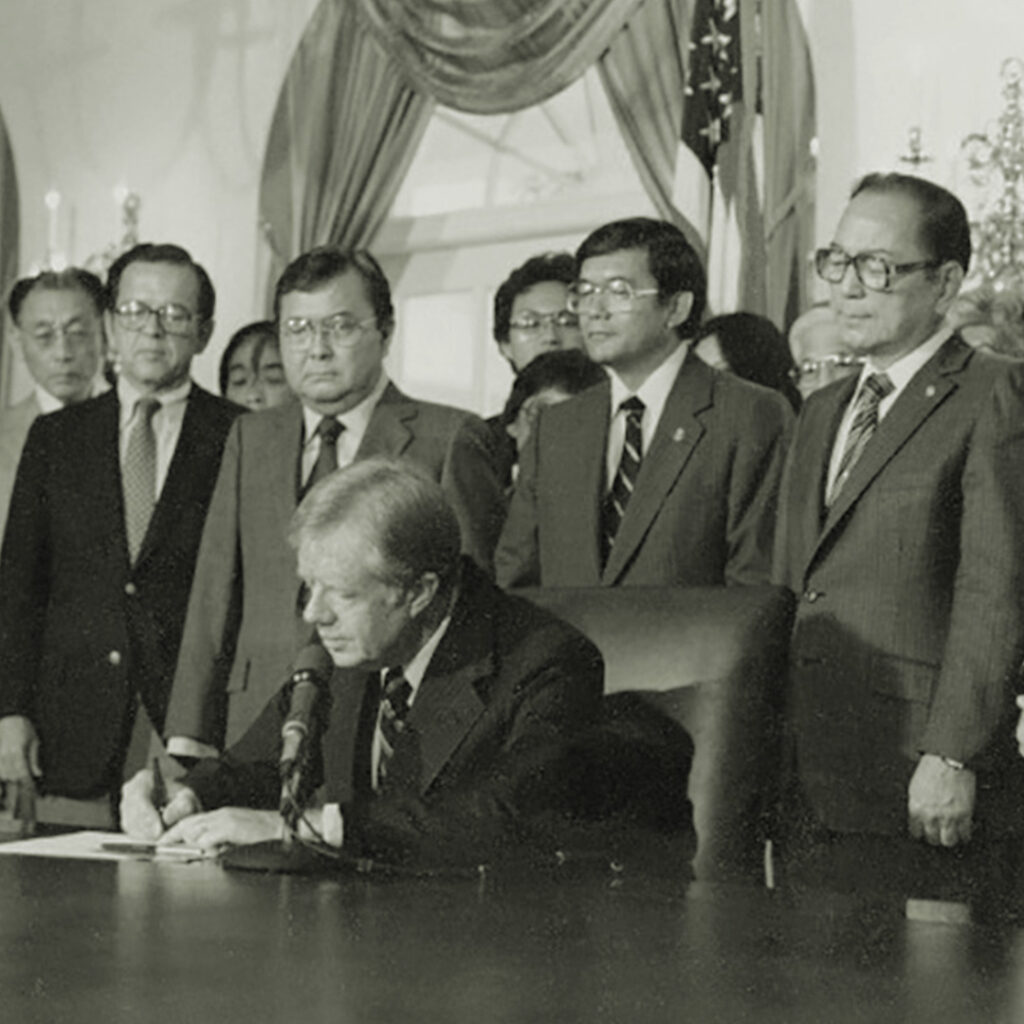
Senator Inouye was instrumental in creating the Commission on Wartime Relocation and Internment of Civilians (CWRIC), which investigated the WWII incarceration of Japanese Americans. The commission’s findings — rooted in testimony and evidence — laid the foundation for redress.
He then played a crucial role in the passage of the Civil Liberties Act of 1988, which formally apologized for the injustice and provided reparations to survivors.
In photos with Presidents Carter and Reagan, Inouye is always present — quietly, powerfully bearing witness.
When Senator Daniel Inouye met President John F. Kennedy, he offered him an honorary membership in the famed 100th Battalion and 442nd Infantry Regiment.
President Jimmy Carter signing the legislation establishing the Commission on Wartime Relocation and Internment of Civilians (CWRIC) on July 31, 1980
President Ronald Reagan delivers remarks at the signing of the Civil Liberties Act of 1988, surrounded by key supporters including Senator Daniel K. Inouye (right).
More than five decades after his heroic service in WWII, Inouye received the nation’s highest military honor for his extraordinary valor on the battlefield.
Nation’s highest civilian honor — awarded posthumously to a lifelong public servant who broke barriers, inspired generations, and never stopped fighting for justice.
He received the Medal of Honor in 2000 — decades after the war.
In 2013, the U.S. Navy named a destroyer after him.
And in 2021, the Daniel K. Inouye Institute was established to carry on his legacy.
He once said: “I represented the people of Hawai‘i and this nation honestly and to the best of my ability. I think I did okay.”
He did far more than okay.
He showed the world what true patriotism looks like.
First Lady Michelle Obama and President Barack Obama present the Presidential Medal of Freedom to Irene Hirano Inouye on behalf of her late husband, Senator Daniel K. Inouye, in 2013.