Perhaps the greatest football team in Wyoming played behind barbed wire.
January 5, 2021: The Eagles of Heart Mountain by Bradford Pearson was published, telling the true story of football, incarceration, and resistance in World War II America.
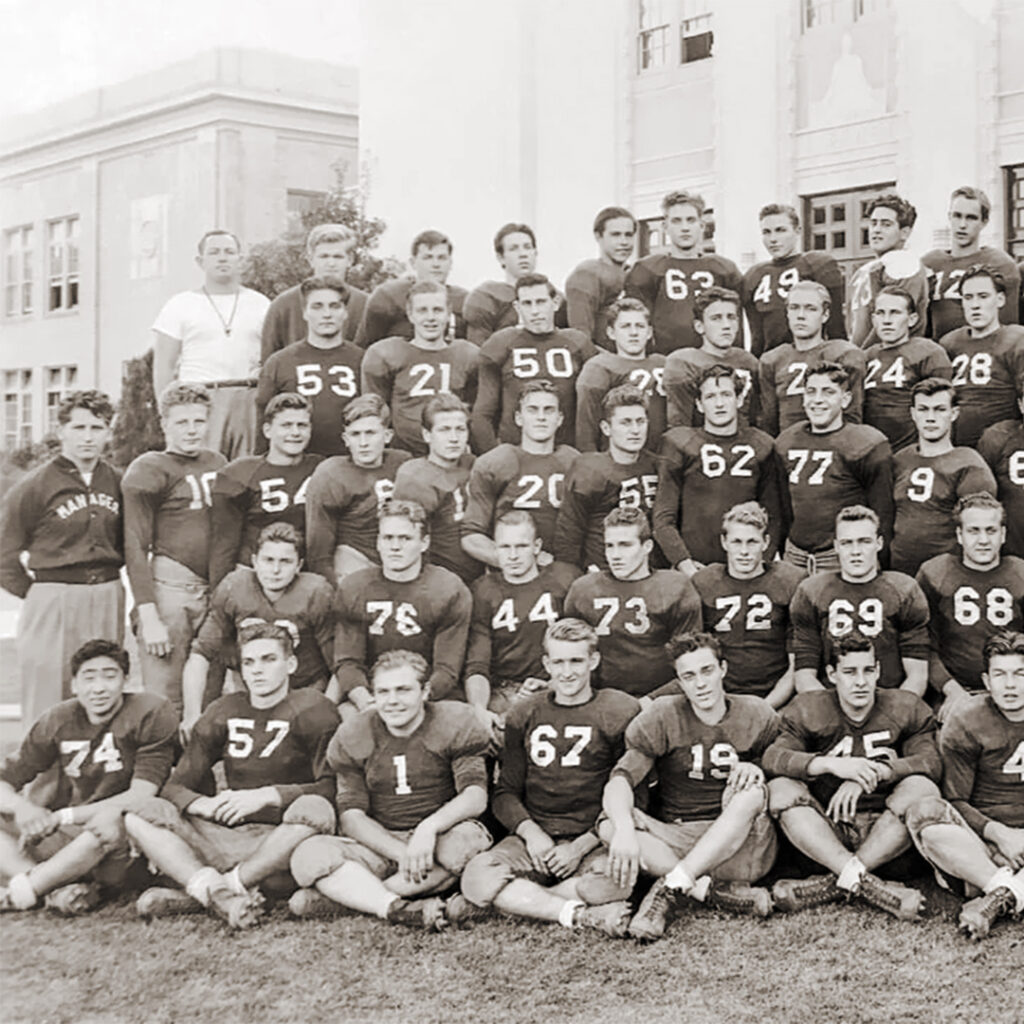
Tamotsu “Babe” Nomura was an athlete who played multiple sports. The lone Japanese American player on the Hollywood High School football team in Los Angeles, he competed in a city that barely made space for players who looked like him.
Then came December 7, 1941.
After Pearl Harbor, Nomura’s life changed abruptly. His family was sent first to a temporary detention center at Santa Anita Racetrack, where thousands of Japanese Americans were held in converted horse stalls under armed guard.
Nomura ran laps on the track to stay in shape. It was there that he met another young athlete, George “Horse” Yoshinaga, who had grown up on a strawberry farm in Mountain View, California. The two bonded quickly and would remain friends for the rest of their lives.
Babe Nomura (bottom left) in Hollywood High School football team, Los Angeles. Babe Nomura was a standout athlete at Hollywood High and the only Asian player on the team.
Santa Anita Racetrack in Arcadia, California transformed into a prison camp in 1942.
The grandstands remained, but the new view was rows of military-style barracks.
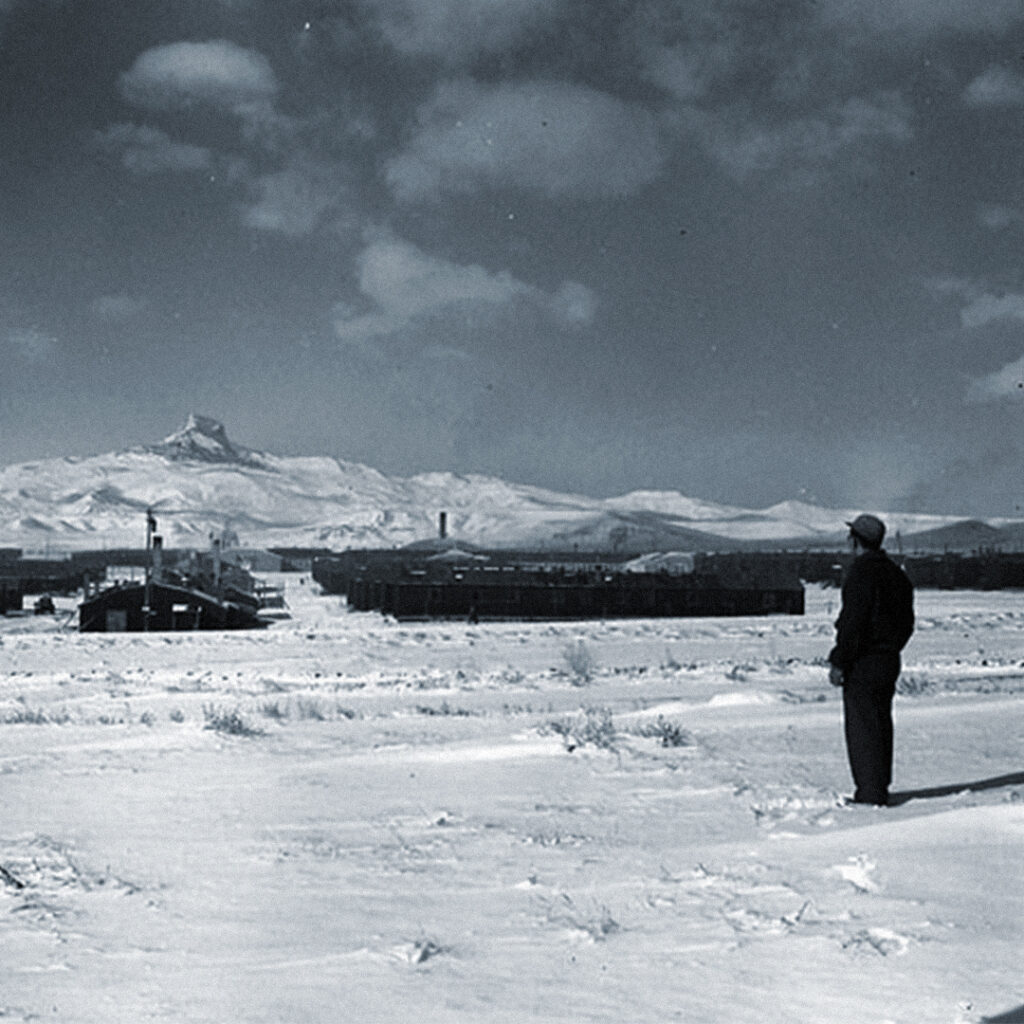
Winter at Heart Mountain was brutal. Temperatures dropped below zero. Barracks offered little insulation. For the incarcerated, survival itself became daily resistance.
Babe Nomura, Horse Yoshinaga, and Keiichi Ikeda posing for the camera, Heart Mountain, fall 1943. Incarcerated, but they were still able to start a team.
From Racetrack to the Wyoming Desert
Like so many others at Santa Anita, both families were eventually transported inland. Their destination was Heart Mountain, an incarceration camp in northern Wyoming.
Conditions were brutal. Summer temperatures routinely exceeded 100 degrees Fahrenheit. Winters plunged below zero. Snow could arrive as early as September, driven by relentless wind across the open plain.
Still, Heart Mountain offered organized sports. There was sumo wrestling, basketball, baseball, and eventually football. In 1943, a football team formed.
The Heart Mountain Eagles were not built like a traditional high school team. Out of roughly 40 players, only three had any prior football experience. Nomura and Yoshinaga were two of them.
The Eagles Soar
They had no proper equipment. Some players wore uniform pants several sizes too large. Cardboard sheets were stacked under clothing as makeshift padding.
What they did have was discipline, athleticism, and cohesion.
On October 1, 1943, in the Eagles’ first-ever game, Nomura threw a last-minute touchdown pass and kicked the extra point to secure a 7–0 victory over the Worland Warriors, a team with a long-established program and a history of titles.
It wasn’t a fluke. Despite being outsized and inexperienced, the Eagles began a winning streak, quickly making a name for themselves across the state.
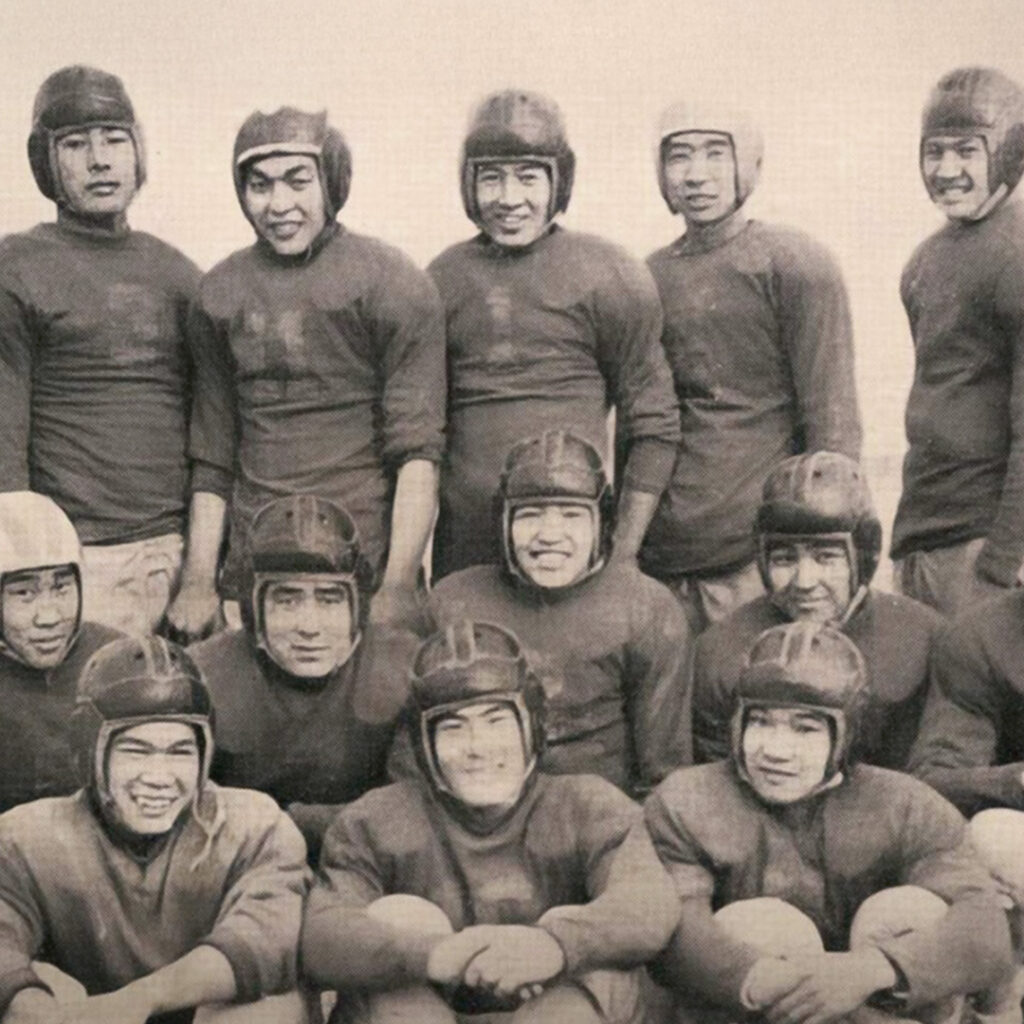
The Heart Mountain Eagles incredibly went undefeated in 1943, playing every game behind barbed wire.
Babe Nomura and Tosh Asano during an intra-camp football game at Heart Mountain, 1943. Friendly rivalries formed and brought much excitement.
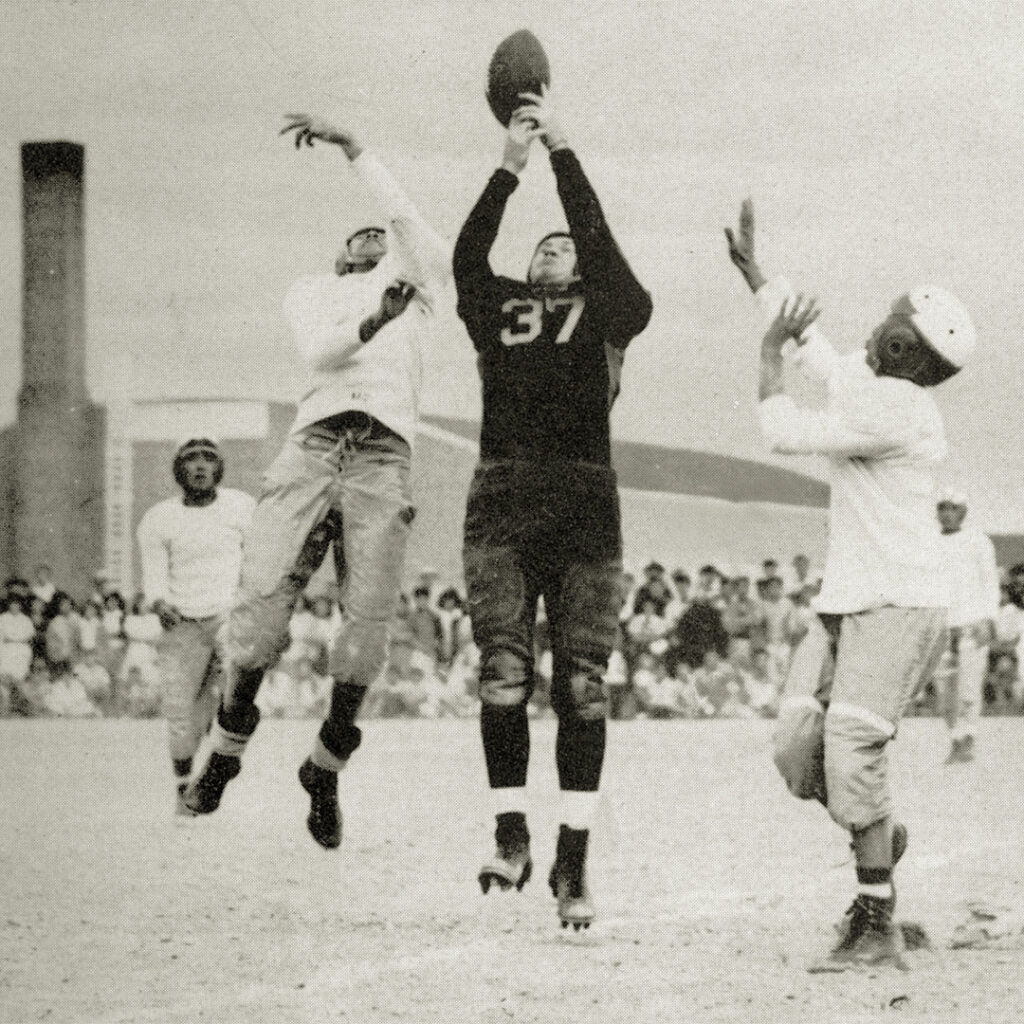
Yoichi Hosozawa defending a pass against Worland High School, September 1944. The Eagles’ second season was nearing its end as players left Heart Mountain.
Horse Yoshinaga during his Army service. A football in hand, carrying a life shaped by sport, incarceration, and war.
Pride Behind Barbed Wire
The Eagles played exclusively at home because they were not permitted to leave the camp. Visiting teams came from surrounding Wyoming towns, many from larger, predominantly white schools. Heart Mountain kept winning.
Thousands of incarcerated people gathered to watch. In a place designed to strip dignity and autonomy, the Eagles gave the camp something rare: pride.
By the second season, leadership shifted. Nomura became head coach. Yoshinaga became the camp sportswriter, documenting the team’s improbable run.
By 1944, players faced the growing likelihood of military service. Yoshinaga later served with the Military Intelligence Service, traveling to Japan for the first time aboard a U.S. military ship after Hiroshima and Nagasaki. Still, the Eagles kept winning, often by wide margins.
Life After the Eagles
Nomura went on to football stardom at Los Angeles City College and San José State University, leading San José State to a Raisin Bowl championship and earning All–West Coast recognition. Tryout offers came from the New York Giants and the Boston Red Sox, but he declined both, choosing instead to work for a seafood company.
Yoshinaga became one of the most respected Japanese American newspaper columnists in the country, shaping postwar discourse through sports and civil rights journalism.
They remained friends until the end.
In two seasons, the Heart Mountain Eagles won six games and lost only one. More importantly, they did something harder to measure.
“It gave everybody in the camp a sense of pride,” former player George Iseri recalled.
The Heart Mountain Eagles. Behind barbed wire, they gave the camp something to rally around, and a reason to stand a little taller.
Published January 5, 2021, this book preserves a story of resilience, resistance, and community formed behind barbed wire at Heart Mountain.
The Book
The Eagles of Heart Mountain by Bradford Pearson was named “One of the Ten Best History Books of 2021” by Smithsonian Magazine.
Pearson’s reporting traces the unlikely rise of the Heart Mountain Eagles and situates their football success within the larger realities of incarceration, resistance, and American contradiction during WWII.