He sacrificed his life, and it didn’t surprise anybody.
August 17, 1922: Sadao Munemori was born in Los Angeles, California.
Sadao Munemori’s fellow soldiers already knew the kind of man he was — the one who would volunteer for the most dangerous job, the one who thought about others before himself. They respected him, they trusted him, and they knew his courage ran deeper than most.
When Sadao’s father passed away, he was just 19 years old. He searched for work to help take care of his mother. But in early 1940s Los Angeles, jobs for Japanese Americans were scarce. There was this thing called racism, which didn’t help.
In November 1941, one month before Pearl Harbor, he volunteered for the U.S. Army.
Sadao Munemori, graduating from Lincoln High School in 1940 — unaware that within two years, he’d be wearing an Army uniform and preparing for war.
Sadao Munemori joined the Army before the attack on Pearl Harbor, then was inducted in February 1942 after his mother and siblings were sent to Manzanar.
Before leaving for Italy, Sadao Munemori visited his mother and siblings at Manzanar. This blurry snapshot is the only known image from that visit.
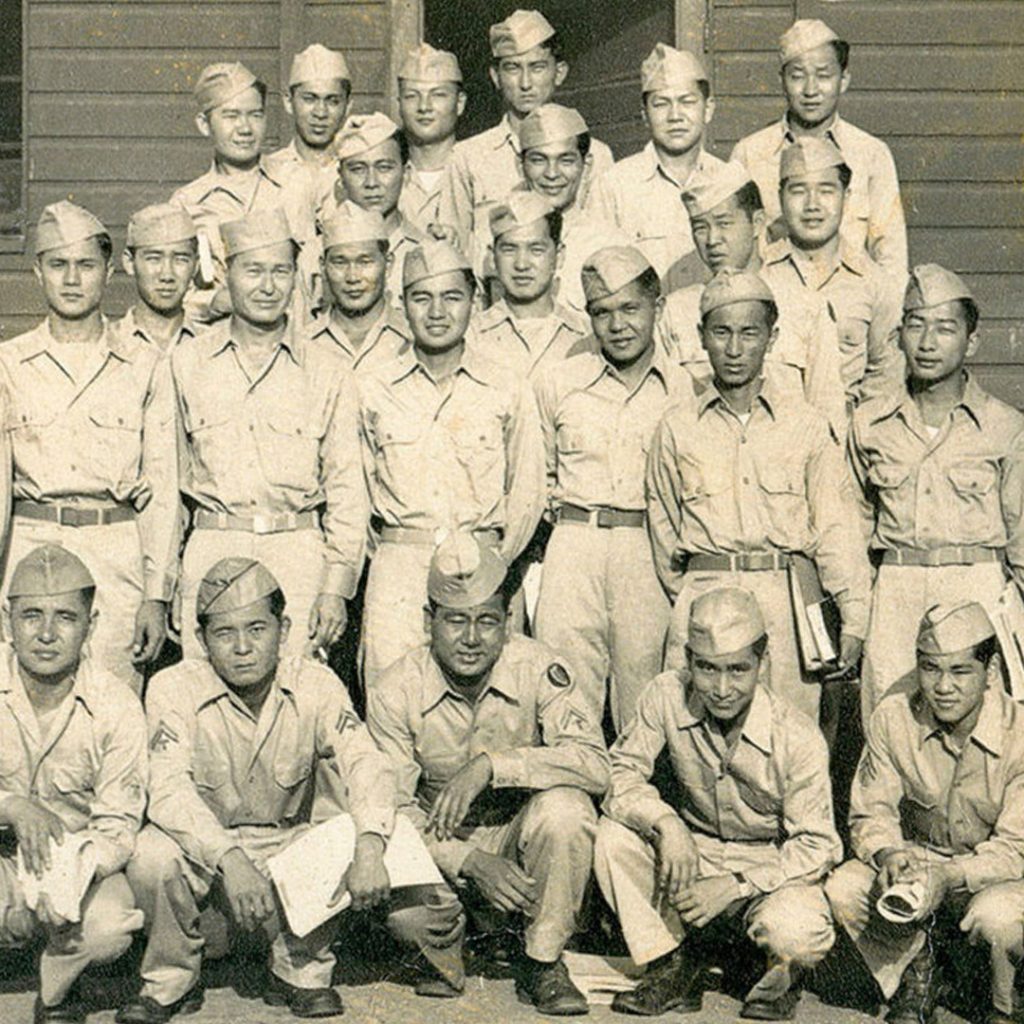
Some members of Company D of MIS Language School, Camp Savage, Minnesota, 1944, credit George Matsunaga
Lieutenant General Mark Clark and C.G. Fifth Army and Secretary of the Navy James Forrestal inspect troops from the 100th Infantry Battalion, Leghorn, Italy
In February 1942, Sadao was inducted into service. His mother and siblings were forcibly removed from their home and sent to Manzanar concentration camp.
Sadao spent his first months in the Army doing menial labor: constructing barracks and cleaning bedpans at military hospitals. In November 1942, he was sent to the Military Intelligence Service Language School at Camp Savage, Minnesota.
When the all–Japanese American 442nd Regimental Combat Team was formed, he volunteered for combat duty — even though it meant giving up his rank of technical sergeant and starting over as a private.
He trained with the 442nd, and joined the 100th Battalion once in Italy. Before shipping out, he took out a life insurance policy so that if he died, his mother would receive $80 a month for the rest of her life.
At the Gothic Line in Italy, Munemori crawled through incoming fire to take out two enemy machine gun nests single-handedly. Then, as he and two fellow soldiers huddled in a shell crater, a grenade landed among them.
Sadao didn’t hesitate. Instead of jumping away, he dove onto it.
The blast killed him instantly, but the two other soldiers escaped with only minor wounds.
When his belongings were sent back to his family, one item stood out: a photo of his mother that he always carried with him — returned with his blood still on it.
Soldiers of the 100th Infantry Battalion making their way toward the Gothic Line in northern Italy — the rugged terrain where Sadao Munemori would make his final stand.
Sadao wrote to his sister Kikuyo he always kept their mom's picture with him. This photo — stained with his blood — was returned after his death.
News of Sadao Munemori’s posthumous Medal of Honor award, detailing how he destroyed two machine gun nests before sacrificing himself to save two fellow soldiers.
Nawa Munemori stands before her son’s memorial at Evergreen Cemetery, holding the Medal of Honor awarded to him posthumously.
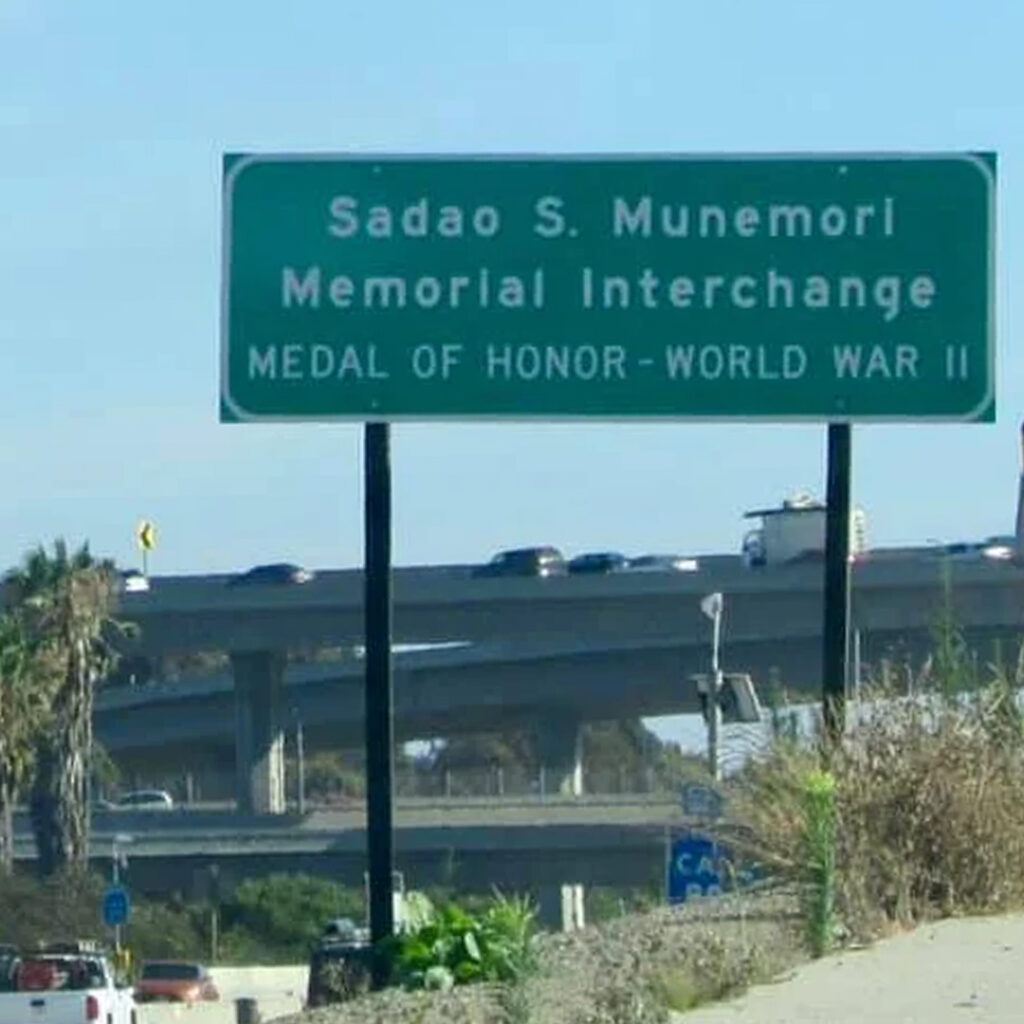
The Sadao S. Munemori Memorial Interchange in Los Angeles — a lasting tribute to the first Japanese American awarded the Medal of Honor.
Private First Class Sadao S. Munemori — remembered not just for how he died, but for how he lived: with courage, loyalty, and an unwavering devotion to those around him.
The men who served with him deeply respected and loved Sadao. They pushed for him to be recognized with the nation’s highest military honor. In 1946, he became the first Japanese American awarded the Medal of Honor.
Since then, his name has been carried far beyond the battlefield. A 10,000-ton Army transport ship was christened the USNS Sadao S. Munemori. A Los Angeles freeway interchange bears his name, as does Memorial Square in Glendale, where he was raised. In Boyle Heights, he rests at Evergreen Cemetery. And across the ocean, in Pietrasanta, Italy — not far from where he gave his life — a monument stands in his honor.
For the men who knew him, there was nothing surprising about what he did that day. But losing him left a hole that could never be filled. Sadao liked people to call him “Spud.” Friendly, outgoing, and accepting — he was the best friend anybody could have.